MMath thesis defence
Inside the Crypto Laundering Machine
A taxonomic study of crypto money laundering schemes and countermeasures
MMath thesis defence
A taxonomic study of crypto money laundering schemes and countermeasures

The paradox
Mallory has just stolen 1,000 ETH.
Every move makes from now on is public. Forever. To anyone with a browser.
will still get away with it.
This thesis is a map of how.
What laundering is
Why Web3
Addresses, not names. The ledger shows who paid whom, never who they are.
No account opening, no questions asked. Anyone can use any protocol.
One network, two hundred jurisdictions, and rules that do not match.
No one holds the funds, so there is no one to subpoena, and nothing to freeze.
Every property that makes DeFi open also makes it easy to abuse.
The gap
Our contribution: a taxonomy that separates what wants from how gets it.
Method
Primer, one of two
* Confidential transactions hide the amount, not the trail. Some sources treat this as a property of its own, others as a layer that sits on top of full anonymity.
Primer, two of two
Lens one
Everything the ledger records, public and permanent.
Lens two
What custodians and platforms know, reachable by legal process.
Lens three
The traces left when value crosses from one chain to another.
The map
The map
Strategies
Strategy three, up close
A solid arrow is a transfer written to a ledger. A dashed arrow never touches one.
Reciprocal, because each payment pays for the other. Disjoint, because no ledger shows the pair.
Privacy-enhancing technologies
Zcash's shielded pool and Tornado Cash are the same construction. One is called a privacy coin, the other a mixer.
Axis one
Random delays, fees, and split outputs. Adds noise so timing and amounts stop matching.
A shared reserve, or many payments merged into one transaction. Ownership becomes a matter of odds.
The linkage breakers. Hide the sender, hide the receiver, or remove the path between them altogether.
Confidentiality only. They hide an amount or a contract's state, but who paid whom stays fully visible.
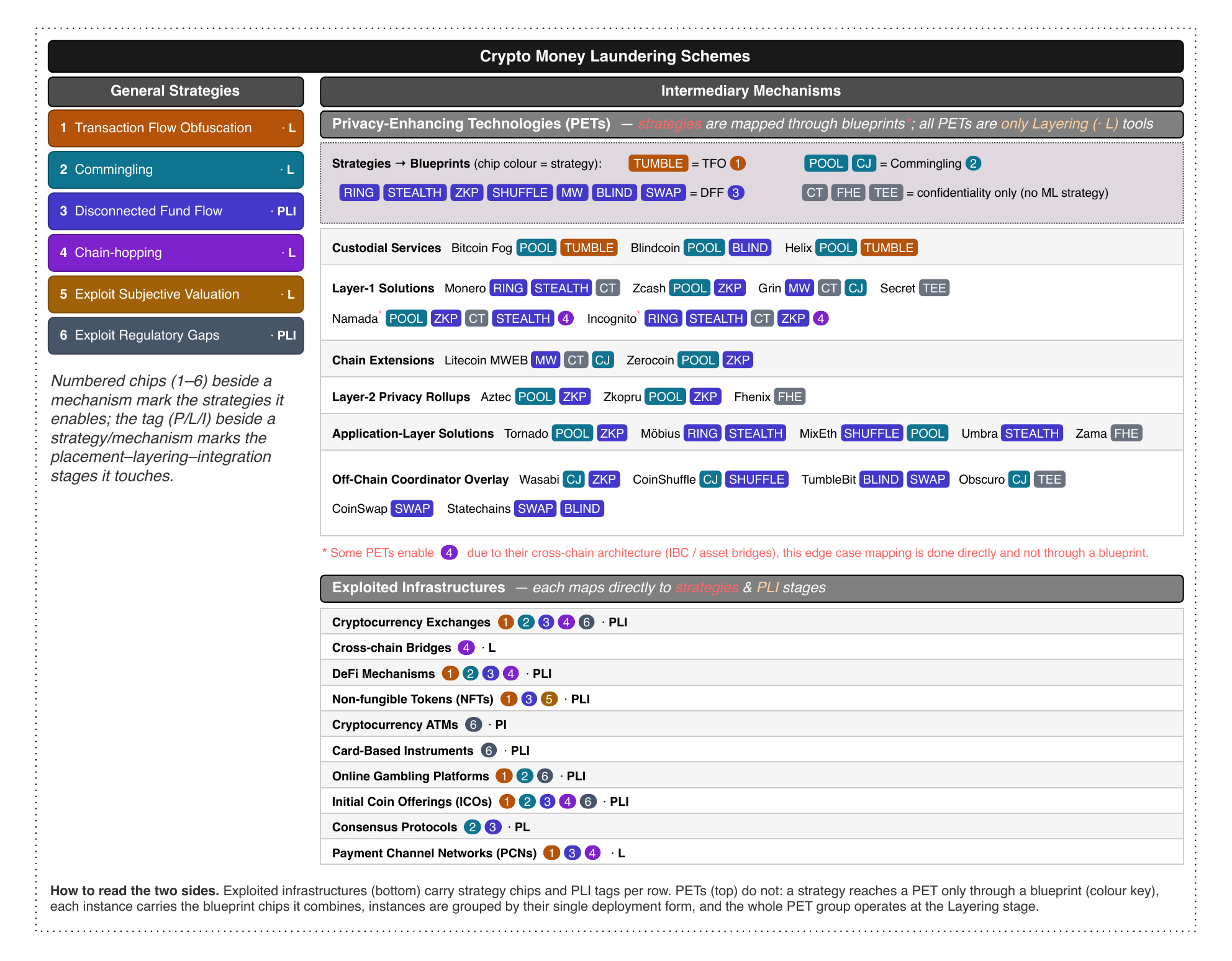
Lego pieces, not a menu. A tool that combines several blueprints inherits the strategies of all of them.
Axis two
CUSTCustodial servicesan operator holds the coins and pays back different ones | Bitcoin Fog POOLTUMBLEHelix POOLTUMBLEChipMixer POOLBlindcoin POOLBLIND |
L1Layer-1privacy built into the chain itself | Monero RINGSTEALTHCTZcash POOLZKPGrin MWCTCJNamada POOLZKPCTSTEALTHIncognito RINGSTEALTHCTZKPSecret TEE |
EXTChain extensionsan opt-in private ledger beside a transparent one | Litecoin MWEB MWCTCJZerocoin POOLZKP |
L2Layer-2 rollupsprivate execution off-chain, proofs on-chain | Aztec POOLZKPZkopru POOLZKPPhenix FHE |
APPApplication layeran ordinary smart contract on a transparent chain | Tornado Cash POOLZKPMöbius RINGSTEALTHMixEth SHUFFLEPOOLUmbra STEALTHZama FHE |
COORDOff-chain coordinatorusers co-sign one joint transaction, nobody holds funds | Wasabi CJZKPCoinShuffle CJSHUFFLETumbleBit BLINDSWAPObscuro CJTEECoinSwap SWAPStatechains SWAPBLIND |
One consequence
Exploited infrastructure
Spotlight one
Spotlight two
Spotlight three
Spotlight four
Countermeasures
Open challenges
What the map shows
Contributions

Questions?
Hesam Sarkhosh · Inside the Crypto Laundering Machine · University of Waterloo, 2026
Backup
Backup
Backup
Backup
TUMBLETumbling. Randomised delays, fees, and output splitting that break timing and amount correlations.
POOLPooling. Funds commingled in a shared reserve or persistent pool; a shielded pool when paired with ZKP or TEE.
CJCoinJoin. Many users' payments merged into one transaction so inputs and outputs cannot be paired.
RINGRing signatures. The true input hidden among decoy signers, so any member is an equally plausible source.
STEALTHStealth addresses. A fresh one-time address per payment, so the receiver's published address never appears on-chain.
ZKPZero-knowledge proofs. Prove ownership of an unspent note without revealing which one.
SHUFFLEShuffle / DC-net. A participant-run permutation, built on multi-party computation, that breaks linkage.
MWMimbleWimble. No addresses; a block's transactions aggregated with cut-through so inputs and outputs cannot be paired.
BLINDBlind signatures. Chaumian tokens that let a coordinator authorise a withdrawal it cannot link to a deposit.
SWAPAtomic swaps. Equal-value coins exchanged through hash time-locked contracts, so no on-chain link is written.
CTConfidential transactions. Commitments and range proofs hide the amount, but not the parties.
FHEFully homomorphic encryption. Computation on encrypted balances and state.
TEETrusted execution environments. Contract state kept inside hardware enclaves that node operators cannot read.
Backup